Repositioning Financial Controller: using Option Solving

A CFO for a fast growing entrepreneurial network engineering company was being challenged by her President to relieve herself of most of the day-to-day tasks of running her financial group. He wanted her to step up and become more strategic and future oriented, assisting with acquisitions and better financial packaging of the technology products that were used in client solutions. To step up she also had to get her people to step up, particularly her controller. Her controller had to take on more of the day-to-day financial activities, in conjunction with being more responsible for the development of her small financial team.

The CFO’s challenge was how to achieve this, especially as her controller was home grown, like herself, and was immersed in the daily detail and routines without looking much at the bigger picture. If you go to the Latest Example, you will see the relatively simple question the CFO posed with an objective sounding board. This brought about the two “bookends” – “Leave controller acting as she is” and at the other end “Consider outsourcing the financial function.” Neither was obviously appropriate but they were another important step to framing the issue that needed to be solved.

Once these were on paper and in the open, the CFO’s mind started racing, drawing upon her considerable intuitive intelligence accumulated over the years. Even though she may never have been posed this exact same issue before, her intuitive mind could find many parallels and similar situations which would help her come up with the most realistic options. As can be seen again in the Latest Example (as well as in the book “Smart Decisions”), the CFO came up with six alternatives before exhausting her options. Then she set them aside for a while, as she worked on some other related matters, to emotionally distance herself from the possibilities. Other activities allowed her intuitive mind to process the information and possibilities in a more subconscious way.

An hour or two later, she returned to her sheet, see Latest Example, and made her intuitive choice. It’s interesting to see a few months further on how both people have made some significant strides. The CFO is getting much more involved in acquisition moves, as well as positioning the company better with its major suppliers. The controller is stepping up to handle more of the daily financial issues, including finding a way to present monthly financials earlier in the month.   (Next week’s posting: Looking at the best option for developing a New Financial Stream…Please also make COMMENTS for connecting with the author)

                                        © 2009-2010 Leadership Solutions Inc® (MALRC). All rights reserved

Enhancing IT: using Option Solving

 IT groups are under scrutiny like never before within the current difficult market conditions. They are expected to produce a whole lot more with less capital invested. So the IT executive I have in mind works for a sizeable financial house with an IT Group of around 75 people.  His CEO is challenging him mightily hard to reduce costs significantly, still meet the business demands of producing new and upgraded projects on time, and still retain good internal relations with his senior peers.

He now gets his “Smart Decisions” book out and begins to frame the right question as discussed in Chapter 3 (see what he comes up with in the Latest Example). If he poses the right question, it will really make him start thinking outside the box. He didn’t choose to involve his team at this point because clearly more than one option would likely include a certain amount of downsizing (with one option on his mind as much as 30%) and he didn’t want to make people nervous until he had his ducks more lined up. So he chose to work with an outsider as a sounding board to start with.

Once his question was in place, he picked two bookends; one was “Remain as we are.” The other was equally a stretch – see Latest Example. However, these really started to tease his mind to come up with reasonable alternatives. With further thought he and his “speaking partner” came up with six, of which three are in the Example given. Because of the emotional challenges in making the right choice (he may have to let some people go), he chose to sleep on it –“emotional distancing” – see Chapter 7.

With his mind made up the following morning, he now had to sell it to his CEO and his peers. He walked them through his Option Solving framework, so they understood the question, bookends and alternatives. At this point he had to be open-minded and flexible to other options and in fact they came up with one he hadn’t considered before. He replaced his B alternative with this one. He then took a straw poll of his colleagues, while they were available, to draw on their “collective wisdom.” Fortunately their choice agreed with his choice and he told them so.

Now he went to meet with his own key team for their consideration and buy-in. This was naturally a much more emotional session owing to the possibility of cutbacks. Even so, he walked them through his question, bookends and options to allow them to add to everything. Once completed, he asked them to remain silent overnight and come back in the morning with there best intuitive option. This they did with a split in opinion, once the confidential straw poll was taken. One faction backed his choice another faction came up with another choice. It was close.

After a quick break, he invited participants (there were 8) to state their intuitive thoughts about one or the other. Allowing time for a fair amount of discussion he asked if people were ready to independently poll again. (He recused himself from contributing to the discussion, since he didn’t want to unduly influence anyone.) A majority wanted more time to think it through, so he invited them to take another night to sleep on it.

Back again the second morning, he took another straw poll and this time the majority went in his direction (at which point he informed them of his own choice). By and large the minority went along with the majority because their voices had been heard. And so now it came time to talk about implementation. (Next week’s posting: How a CFO had to reposition her financial manager/controller…Please also make COMMENTS for connecting with the author)

                                        © 2009-2010 Leadership Solutions Inc® (MALRC). All rights reserved

Significant Non-Profit Financial Crunch: using Option Solving

Non-profits are facing enormous funding challenges right now unless, of course, they are directly connected with the Haitian earthquake disaster. This is combined with their particular challenge in recent years, where the donor trend has been toward making specific spending requests for their donations. Such reasonable requests have severely reduced the amount non-profits can spend on general administrative and running expenses. Added to this, for most not-for-profits, have been their income reductions during 2009 and now with the Haitian disaster most giving is going in that direction.

By mid-year 2009 an important international arts festival in a large north east US city was facing an impending squeeze on its state and local funding. It was fretting over how it was going to be able to sustain its incredible success over the years. Its executive director found herself pondering, with a couple of objective outsiders, how the festival could position itself, going into its summer festival, to avoid major cuts in its fall budget negotiations.

There was considerable discussion about the key question to be asked (see book “Smart Decisions”) and Latest Example. Once this was decided it was easier to determine the two bookends: again see Latest Example. Both were clearly unacceptable.

With these in place (see Latest Example), the executive director was able to see her immediate options. In this case, the proximity of the discussion to the actual event inhibited her ability to apply the best alternative. But the discussion helped her to see how valuable this exercise could be, so she requested a separate option solving session with her board members (post-the-event), where a new “one-mind” consensus could be hashed out on the best way forward. (Next week’s posting: How an IT executive solved his latest upgrade and downsize issues…Please also make COMMENTS for connecting with the author)

                                        © 2009-2010 Leadership Solutions Inc® (MALRC). All rights reserved

Strategic Future of ABC: using Option Solving

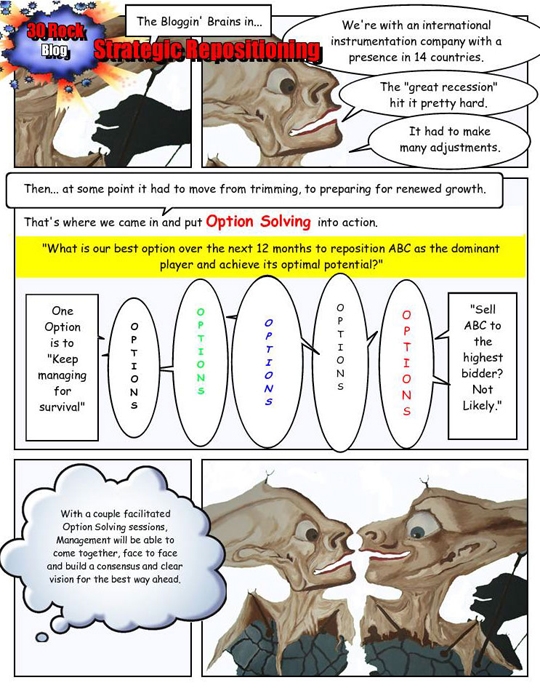
Our option solving candidate for this week: an international instrumentation company with a presence in 14 countries. It has several manufacturing locations strategically located with a marketing reach of many more, besides its subsidiary entities.

The “great recession” hit it pretty hard like so many other OEM suppliers, especially since it worked with many of the major equipment suppliers in the world. It had to make many adjustments to retain its financial viability: such as closing marginal units and trimming its workforce wherever it made business sense. However, at some point it had to move from trimming to preparing for renewed growth but, like so many others, was faced with a tough banking and credit situation. This reality, as with countless other manufacturers, is destined to limit its re-expansion without some creative resource initiatives.

One of its key executives decided to speculate about its future options before proposing fresh ideas to his colleagues. To aid his thinking and objectivity he chose to work with an outside resource and together they put together an appropriate question, which took a reasonable amount of debate and time. This turned out to be: “What is our best option over the next 12 months to reposition ABC as the dominant player and achieve its optimal potential?”

Once in place, he was able to identify the two “bookends” (see Smart Decisions book) that would form choice boundaries for his question. These were: at one end, “Keep managing for survival,” and at the other end, “Sell ABC to the highest bidder.” Since both were unacceptable options at that moment in time, for a whole host of reasons, they served to spark this executive’s intuitive intelligence into a strongly creative but strategic mode.

If you now go to the Latest Example, you will see some of the options he developed from which he made his final choice after he slept on all his options overnight. This latter sleep activity is called “emotional distancing,” which allows the intuitive intelligence to work at its best; to make all the trade-offs and weigh the alternatives while asleep. In the book you will see the reasoning for this phenomenon.

At some point, he and his senior colleagues from around the world will need to build a consensus for the best way ahead. With the Latest Example version in his back pocket, he will be in a position to lead such a discussion: although, since the group will swell to around 25, he should consider using an outside facilitator. A capable leader should be able to orchestrate up to 10 executives through such an exercise but when the numbers get higher, there’s much to be gained from using an experienced outsider to facilitate such discussions. Another advantage of using outside facilitators is that they have usually seen a variety of approaches for resolving different company issues, consequently can add to the creativity pool.

Experienced facilitators can also aid splitting larger groups into sub-groups, to aid participant involvement, since those on the fringes will not necessarily buy-into the activity or final outcome…more about larger groups in the book “Smart Decisions.”

This company did come up with an appropriate option and is now better positioned to steadily grow again in a difficult marketplace (Next week’s posting: Significant not-for-profit facing major finance crunch…Please also make COMMENTS for connecting with the author)

                                        © 2009-2010 Leadership Solutions Inc® (MALRC). All rights reserved

HR Team not Meeting Expectations: using Option Solving

Our option solving candidate for this week: an international financial organization with a substantial branch presence in the US. It has been operating from its New York base for 20-30 years and its America’s workforce is large enough to warrant a small human resources team.

Over the past 4-5 years people within the branch have become increasingly frustrated with the HR team’s effectiveness: it is currently responsible for salary and benefit administration, as well as assisting in recruitment, new employee orientation and training activities. With a fair number of expatriates within the branch, their issues also have to be handled.

With a new general manager in place over the past 2 years, who has ambitious plans for the group, the HR team’s effectiveness came further into the spotlight. One of the branch leadership team was assigned to resolve the issue, even though that person has no defined experience in the HR field. His challenge: to find an acceptable solution as quickly as possible.

Fortunately he is conversant with the option solving technique, so he immediately sets about formulating an appropriate question. Once the appropriate issues or are highlighted, it turns out to be as follows: “What is our best option for handling our current HR function, so that it will be effective, up-to-date and communicate HR issues promptly?”

With this in place, he is now positioned to identify the two “bookends” (see Smart Decisions book) to help frame his deliberations. These were: at one end, “Stay as we are,” and at the other end, “Completely replace the team.” Both were unacceptable choices at this moment in time, for a variety of reasons, but they served to spur the executive’s intuitive intelligence into high creative gear.

A little help from some confidantes with HR experience enables him to come up with the following options: A)?, B) Train and coach current people, C)?, D) Outsource some of what we currently do, E)?, and F) Get an outside HR professional to review the situation – see Latest Example.

Again, this non-executive’s choice is not important, since only he has the best contextual perspective to pick the optimum option with his experience laden intuitive intelligence. Even so, once his choice is made, he is able to meet with his general manager and walk that individual through his thinking and final option: chances are the general manager will go along with it…a good step accomplished. His clear framing, alternatives and intuitive choice provide the arguments and intuitive reasoning to convince his own leader, as well as himself.

It will be a surprise if good progress is not made within the near future and sooner rather than later the enterprise will be able to put the issue behind it: hence good momentum is sustained.  (Next week’s posting: Taking the best fundamental strategic decision to move a business forward using Option Solving.)

                                        © 2009-2010 Leadership Solutions Inc® (MALRC). All rights reserved

Resolving Veterinary Practice Challenges: with Option Solving

Owner veterinarians have many role advantages, not least orchestrating their “own show.” But they also have their practice challenges, too. Sometimes they have no-one else to discuss particular sensitive issues with, other than with other owner veterinarians. The latter are not always available when needed and then there’s the owners’ bias toward trying to resolve things themselves. This is where Option Solving can help as a valuable decision making tool.

You can find an incomplete example under the Latest Example tag: incomplete to discourage readers from the temptation of believing that other people’s solutions will be their solutions, too…especially with regard to Option Solving. The example outlines a typical challenge for owner veterinarians, where an associate veterinarian (Sarah) wishes to drop a work day because she has moved another part of town. Sarah has been working at the practice for a few years and has built up a healthy following on her two days of practice. Unfortunately she wasn’t interested in buying into the practice.

As is often the case, Sarah’s personal relationships had changed and she wanted to relocate to make a fresh start. She had also found an owner veterinarian in her new neighborhood that was willing to take her aboard: initially for a day or two per week. It was a jolt to her current owner practitioner, who had seen Sarah as a capable and reliable producer. Finding such veterinarians is not easy: one of the realities for owners.

For the practice owner the first step in Sarah’s case is to reduce her involvement from two to one day per week, with the strong likelihood she will then vacate all together. Faced with this prospect the owner derives an option solving question (see more about this in “Smart Decisions”): “What is my best option in place of Sarah on Wednesdays (she will still do Fridays), so as to hang on to her client following and meet her standards?”

Once the right question is in place, the owner’s next step is to formulate the “bookends” for spurring the owner’s intuitive mind to figure out the best range of options. Those happened to be: 1) Work alone on Wednesdays, and at the other end 2) Close down the practice on Wednesdays. Both were good because, although options, they were the least likely the owner’s intuition would accept.

Now the owner is in a position to consider options in between. With the owner’s intuitive mind pushing away from these bookends, other options start to flow: A) Find a good match for Sarah’s clients, B)?, C) Appeal to Sarah to extend her stay until we find the right person, D)?, E) Do not replace Sarah across the board, or F)? – see blog Latest Example.

The owner made an appropriate choice, after a night to sleep on it (see “emotional distancing” in the book), which is not important to discuss in light of the earlier point. However, with this intuitive choice comes peace of mind, knowing that all the best options have been considered and the owner’s best judgment tool (the intuitive mind) has done its job. (Next week’s posting: How to deal with an HR team that doesn’t seem to be meeting expectations.)

                                        © 2009-2010 Leadership Solutions Inc® (MALRC). All rights reserved

Dilemma of First Job Exposure: resolved with Option Solving

 My other wonderful daughter (M), who is a psychology sophomore, had figured out how much extra spends she would have, if she could secure a part-time bar-tending job. She also cutely figured out how her studies could be enhanced working as a bar-tender by giving her a terrific “fishbowl” view of the many personalities that hang around bars. So, recently she completed a two-day bar-tender’s course in New Jersey and ended up with an appropriate certificate.

Next step: find a bar-tending agency in Manhattan, which she did. Recently she attended her first interview, by way of an agency, at a “hookah” (mid-east pipe smoking) bar on Manhattan’s West Side. Being such an attractive and “cool” young lady, she was quickly hired: although on the basis she would have to wait tables as well.

In due course her first outing at the “hookah” bar occurred: where we all wished her well. But, within the first 2 hours, her sister received a cell phone call from M asking for advice: “Should she come or hang-around?” She was informed she would receive no pay, only tips. She informed her sister that the bar was dead quiet and she was just hanging out reading. The manager was hardly communicating with her: probably anticipating like so managers that people should – by magic – know what to do; no orientation necessary!

What should she do? Her sister handed over the phone to Dad, who naturally suggested she consider her options. The question for such an exercise was quite straight forward: “What should I do, come home or stay?” Moving straight to her situation bookends (see the book), she quickly came up with at one end – Sit and hang out reading: and at the opposite end – Leave in a fit of rage. Neither of these two extreme options appealed to her, which really helped get her creative, intuitive juices flowing.

She eventually came up with seven alternative options for consideration (see Latest Example), which included: A?, B-Go home if things don’t change in the next 30-60 minutes, C?, D – Request bar-tending as opposed to waiting tables (as per her original expectation),  E?, F – Call agency and ask its advice, G? (Learn more about compiling these options from the book.)

Again, her final intuitive choice is not important, since she’s the only person who could make that judgment in light of her particular situation at the time. More valuable was her ability to figure out her best call for herself, not her parents. Figuring things out made her feel more secure within herself that she could handle these early job challenges. She would also be able to demonstrate to the agency that she handled the situation with some maturity, rather than “act out.” She is now better equipped to use Option Solving in the future based upon this practical experience. (Next week’s posting: Dealing with a veterinarian’s office issues.)

                                        © 2009-2010 Leadership Solutions Inc® (MALRC). All rights reserved

New Year’s Personal Resolution/Focus and Option Solving

Going back to December 24th’s posting, we will probably have our professional/career priority or focus set for 2010 by now. This allows us the time to focus on our personal resolutions for the New Year. Of course there are those who would argue for doing it the other way around and that will be fine, too. Although there are some lucky folks who have an inner compass that keeps their lives on track over the course of a year, most other folks will do much better by clarifying their personal focus by early 2010.

With the use of Option Solving, your first step is to define the right question. Take the example of a widower friend: his wife died when their kids were still teenagers. His question could be, What focus will give my personal life a real boost in 2010, so that I can feel centered, have consistent companionship and enrich my life in other ways?”

Getting this question right is an important beginning but establishing the right, contrary bookends are just as important: for example, 1) Keep paddling away with current unclear relationships, and, at the other end, 2)Take off for Europe and return with a new bride. As a European who has lived in the US for many years, with two grown American offspring, the latter would not be totally off the wall but highly unlikely.

Bookends spur the more creative juices to start working as the intuitive mind starts searching for other more appropriate options between these two unlikely, diverse alternatives (see Chapters 5 & 6 in the book). Potential options for him would include: A)?, or B) Join a quality dating house, or C) Immerse myself in my seafaring hobby, or D)?, or E) Revisit all recent happier relationships and rekindle the right ones.

What he chooses is not important to dwell on, since only he can determine his intuitive, rather than rational, choices as he sees them. But, after an appropriate degree of “emotional distancing’ (see book), he can benefit from at least 5 alternatives for his intuitive senses to assess and choose his best possibility. Either within a few hours break or an overnight recess, he would come out with a clear choice. He will then be committed to that choice because he will have considered all other reasonable choices: this is a major benefit from option solving…rather than continuing to second guess himself. (Note: The next posting about my other student-daughter’s option solving exercise, to determine how to deal with a new part-time hookah bar job, will be within 7 days.)

Happy Holidays: New Year’s Priorities/Focus and Option Solving


As the holiday season arrives, with New Year closely on its heels, many people will be thinking about their focus and priorities for 2010. Success in this endeavor could make the difference between feeling you had a great year, this time next year, both personally and professionally, or feeling quite frustrated owing to inadequate progress in both departments.

Perhaps this means we have to consider completing two Option Solving exercises, one for our career and professional lives and the other for our personal lives. So maybe it makes sense for me to move forward on my career and professional side for now and then we can address the personal side in my next posting within the next 7 days.

As per the book, “Smart Decisions: Goodbye Problems, Hello Options” (see Order Book): the first thing we have to formulate is the most effective question. In my case, it could be : “What is the most important factor that I have to focus on during 2010 within Leadership Solutions (see Website www.ileadershipsolutions.com-click on) in order for it to continue growing, increase its client and brand awareness, and maximize its income stream for future client value investment?”

Once this question is established, then I can determine the two most likely bookends (see Chapter 3 in the book). By putting these in place, they will help to frame my thinking and, because of their extreme nature, will challenge my intuitive mind to surface the most sensible and valuable alternatives. Two bookends which most immediately spring to mind are: 1) Take an opportunistic and undefined approach, and at the other end 2) Invest my energies in a totally fresh market direction.

Now in your case, you also have to develop a meaningful question and then two bookends to prod your intuitive mind to encourage you to become imaginative and thoughtful about next year’s potential priorities and focus. Once the question and bookends are in place, you will sense your intuitive mind pushing your bookends away “out of sight” as it attempts to come up with the most realistic priorities (options) for your 2010 year.

In my particular case, I thought of eight different potential focus areas, four of which were: A) Write a second book, or C) Develop more products/leadership tools, or E) Further develop this blog, or G) Develop some new clients (see Latest Example).

Owing to the interdependability of the choices, it will require the maximum distillation by my intuitive mind to come up with the best option. To enable this to occur, it will require an adequate period of “emotional distancing” (see Chapter 7 in the book) to really permit my intuitive mind to weigh the pros and cons and make the necessary “trade-offs” to make an optimum choice. It will be able to do this based upon the countless experiences and stories I’ve heard or read over the years.

Consequently, I’m going to sleep on them tonight, asking myself the earlier question and looking at my eight options before I go to sleep. When I wake up tomorrow, the first choice that comes to mind will become my primary focus for 2010. That’s not to say I will ignore the others: they will be attended to as things unfold.

One other thing I will probably do, as a counterpoint, is to ask my colleagues for their input. I will take an independent poll and, if I’m lucky, they will agree with my choice. If not, I will take their poll into account and have another night of emotional distancing and respond to my intuitive choice the following morning – choosing between their option and my original option. Whichever one my intuition lands upon will then become my primary focus for 2010.   (NOTE: Next week we can deal with your personal focus for 2010.)

Daughter Removing Misery from Supervisory Challenges with Option Solving


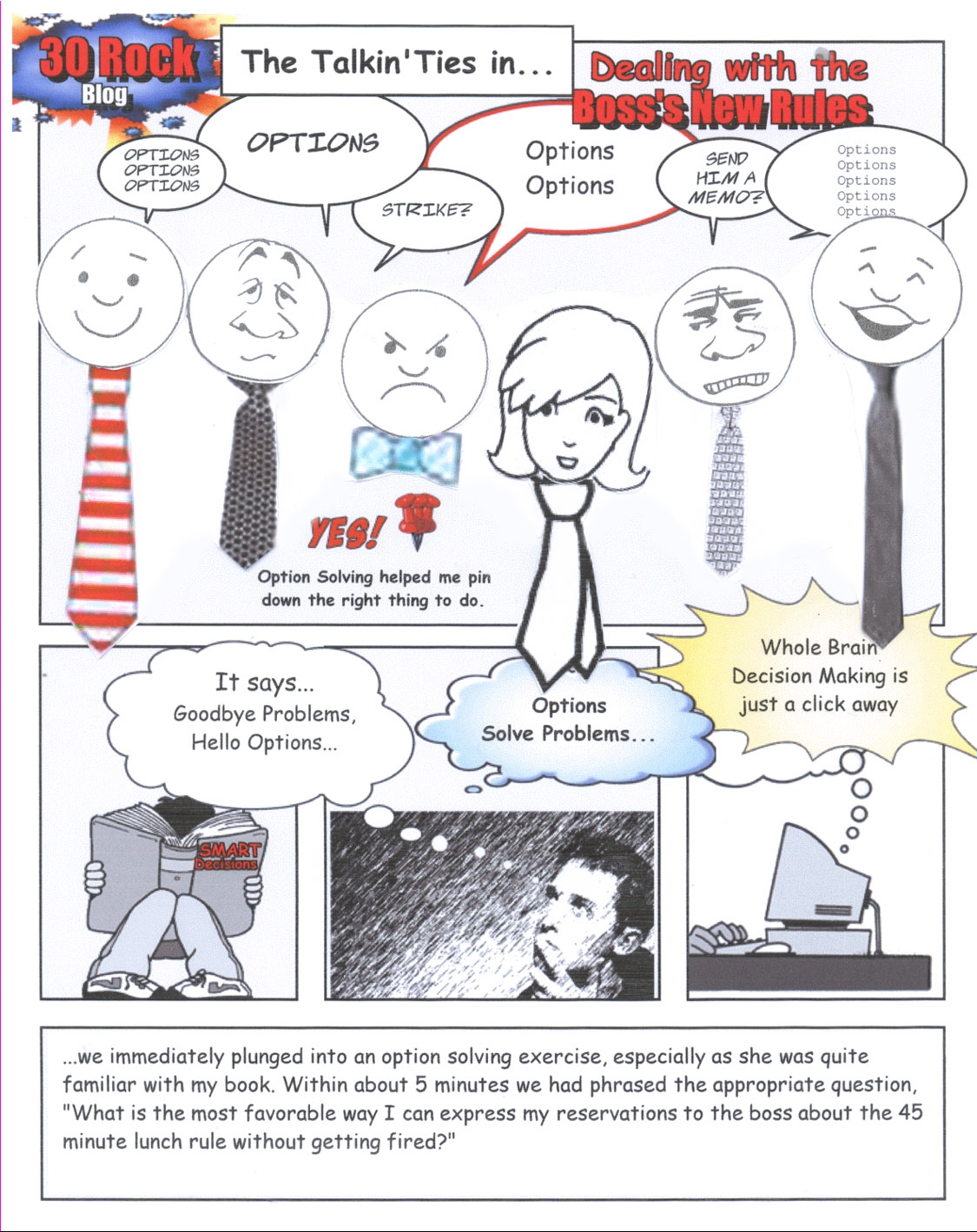
A few weeks ago over dinner, my university preoccupied daughter raised a question about her occasional “side” job: “What should I be doing to deal with a new employer rule requiring us to take a 45 minute lunch break without pay?” Although studying to be a commercial pilot, she welcomed the sporadic job for a little extra spending money. She is required to waitress tables or be behind the bar at a major local sports venue in its VIP lounge, when it has events for VIPs, celebrities or charitable events.

Instead of offering advice (not a great idea), we immediately plunged into an option solving exercise, especially as she was quite familiar with my book. Within about 5 minutes we had phrased the appropriate question, “What is the most favorable way I can express my reservations about the 45 minute lunch rule without getting fired?” (See also Latest Example). 

This is a typical dilemma for many workplace people, who suddenly find themselves stuck at the end of newly imposed rule (sometimes seemingly unfair) with scant explanation. The challenge for the employee is either to swallow or address it. In this case, my daughter obviously wanted to address it.

We then debated the two bookends (see more in Chapter 3 of the book) and came up with, 1) Continue to feel miserable about it, or 2) Raise bloody hell. Neither of these were appropriate but they started prodding her intuitive mind to come up with viable alternatives.

Eventually we came up with six viable options, three of which were: A) Do nothing about it, or C) Bring my feelings to the company’s attention by letter when I leave next summer, or E) Make a suggestion to add an extra hour to work schedules to compensate. She ultimately chose one of the three others but her solution is not important (See Latest Example).

What is more important is that:

  • She came to her own conclusion
  • She didn’t feel trapped by her dilemma anymore
  • She determined her best course of action at that moment in time
  • She quickly reduced her level of anxiety about the issue

These are some of the benefits you can experience by using Option Solving (see Order Book).You don’t have to wrestle with tough employer dilemmas anymore (NOTE: There will be another posting within a week.)